

If you’re a homeowner in Toronto, sewer backups are a serious risk, especially with our city’s aging infrastructure. When a massive storm hits, the municipal sewer system can get overwhelmed, pushing wastewater right back into your basement. This isn’t just a mess; it’s a costly disaster that can damage your foundation, ruin property, and create health hazards. For any Toronto home facing this threat, installing a backwater valve is the most effective safeguard, a solution G1000 Home Substructure has specialized in for over 25 years. We never cut corners, ensuring your home is protected with an engineered solution built to last.
What Homeowners in Toronto Need to Know About Sewer Backups
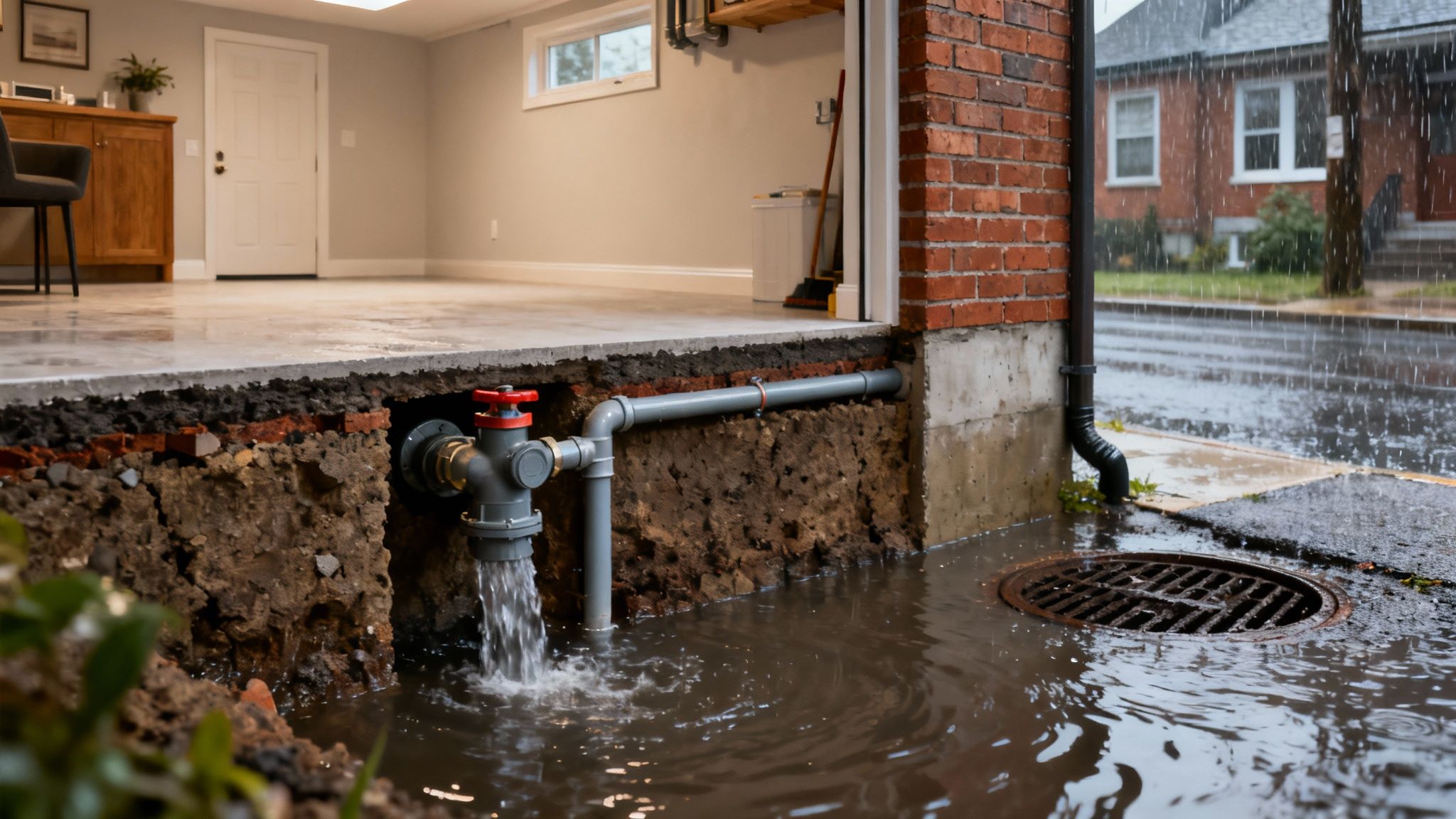
A backwater valve is essentially a one-way security gate for your home’s main drain line. It allows wastewater to flow out but slams shut the moment sewage tries to flow back in from an overloaded city sewer. When heavy rainfall overwhelms Toronto’s sewers, this device is your first and best line of defence.
With over 25 years of experience in foundations and waterproofing across the GTA, we’ve seen the damage that shifting Toronto clay soil and intense storms can do. Homes in older neighbourhoods, particularly those with deep basements in areas like Scarborough or Etobicoke, are especially vulnerable. Without a backwater valve, your home becomes the path of least resistance for the city’s overflowing sewers.
The Role of a Backwater Valve
In simple terms, it’s a check valve for your home’s entire plumbing system. A flap inside the valve stays open during normal use, allowing wastewater to exit freely. But when the city sewers surcharge, the backflow pressure forces that flap closed, creating a watertight seal. It’s a simple mechanical action, but it’s incredibly effective at preventing a major disaster.
Here’s a rule of thumb I always share with homeowners: if your basement floor drain is lower than the next upstream manhole cover on your street, you are at high risk. Gravity is not your friend in this situation. Any backup in the city main will naturally find the lowest point to escape—often your basement. We cover more scenarios in our guide on how to prevent basement flooding.
Why Professional Installation Matters
While the concept is straightforward, installing a backwater valve is not a DIY job. This isn’t like changing a faucet. It involves breaking concrete and cutting into your home’s main sewer lateral—a critical piece of your plumbing infrastructure. A mistake here could lead to a valve that fails right when you need it or causes chronic drainage problems.
A proper, professional installation is all about precision and durability. We never cut corners. The process involves:
- Locating the Main Drain: We pinpoint the exact location where your home’s main drain line exits through the foundation wall.
- Excavation and Preparation: We carefully remove a small section of your concrete floor to expose the pipe.
- Precise Installation: The valve is installed with the correct slope and sealed with watertight connections to guarantee flawless operation.
- Concrete Restoration: We restore the concrete floor, leaving your basement secure and fully protected.
When you invest in a professionally installed backwater valve, you’re buying peace of mind.
What Causes Sewer Backups in Toronto?
Too many Toronto homeowners only discover their property is vulnerable to a sewer backup after their basement is already flooded. The key is to get ahead of the problem. Don’t wait for a disaster to find out your home is at risk.
The biggest factor we see is simple physics. If your basement floor drain is lower than the city sewer manhole on your street, gravity works against you. During a heavy downpour, the overloaded city sewer system will look for the easiest escape route, which is often right up your pipes and into your home. This is a classic setup in many of Toronto’s older neighbourhoods, where homes with deep basements were built decades before modern drainage standards.
Key Red Flags for Toronto Homeowners
Beyond the gravity test, a few other signs can signal a high risk of backup. If any of these sound like your home, a backwater valve isn’t just a good idea—it’s essential protection.
- Your Home’s Age: Was your house built before the 1980s? You’re likely connected to an older combined sewer system where stormwater and raw sewage share one pipe—a system that gets overwhelmed fast in a storm.
- Your Neighbourhood’s History: If your neighbours experience basement flooding every time it rains, the local sewer infrastructure is clearly struggling to keep up.
- The Lay of the Land: Homes at the bottom of a hill or in a low-lying area are natural targets. Water and sewage flow downhill, and your home could be the final destination.
Expert Insight: The quickest DIY check is the “manhole test.” Go outside and look for the closest municipal sewer manhole on your street. If that cover is sitting higher than your basement floor, your home is at risk. It’s a simple test that flags thousands of vulnerable GTA properties.
Are you unsure if your home is a candidate for a sewer backup? This quick checklist covers the most common high-risk factors we see.
Quick Risk Assessment for Toronto Sewer Backups
| Risk Factor | High-Risk Indicator | Why It Matters |
|---|---|---|
| Home Age | Built before the 1980s | Likely connected to an older, combined sewer system that is easily overwhelmed by heavy rain. |
| Topography | Located in a low-lying area or at the bottom of a slope | Gravity directs overflowing city sewer water toward your property first. |
| Basement Elevation | Your basement floor is lower than the street’s sewer manhole | Creates a direct path for sewage to back up into your home during a system overload. |
| Neighbourhood Flooding | Neighbours have experienced basement flooding | A clear sign that the local municipal sewer system is under strain and can’t handle storm surges. |
| Large Trees on Property | Mature trees are located near your home’s sewer line | Tree roots can infiltrate and block your sewer lateral, causing backups even during normal conditions. |
If you checked one or more of these boxes, your home has a significantly higher risk of experiencing a damaging and costly sewer backup.
The Elevation Test: A Simple Home Assessment
You don’t need any fancy tools to get a rough idea of your risk. The number one indicator is comparing the height of your lowest drain to the nearest upstream sewer manhole. If your drain is lower, a valve is a must-have.
This visual check is one of the first things we do during an on-site consultation because it instantly tells us how exposed the home is. If you’re not sure how to interpret what you see, that’s what we’re here for. We can also walk you through the important role of basement floor drains in your home’s plumbing system.
Our Solution — Step-by-Step Backwater Valve Installation
A backwater valve is only as good as its installation. At G1000 Home Substructure, we treat this job with the precision that comes from over 25 years of hands-on foundation and waterproofing work. Our process is methodical and built to last.
Step 1: Camera Inspection and Site Assessment
Before a single tool comes out, we run a camera down your main sewer line. This helps us find the perfect spot for the valve and serves as a crucial health check for your pipes, allowing us to identify existing cracks, tree roots, or blockages that must be addressed first. The valve must be placed on the main drain after all your home’s plumbing fixtures but before the pipe leaves the foundation to ensure complete protection.
Step 2: Permits and Site Preparation
Installing a backwater valve is a modification to your home’s main drainage system, which requires a city permit. We handle the entire permitting process, ensuring every part of the job is fully compliant with Toronto building codes. This paperwork is also critical for your home insurance and city rebate eligibility. Once permits are approved, our crew sets up dust-control measures to keep your home clean.
Step 3: Precise Excavation to Expose the Pipe
With the location confirmed, our licensed team makes a clean, precise cut in your concrete floor to expose the main sewer lateral. Our deep experience in concrete services means this is done with minimal mess and disruption. We dig down carefully, ensuring the surrounding soil is stable and ready for the valve.
This diagram shows exactly why a backwater valve is so critical. When the city sewer manhole is higher than your basement drain, gravity works against you during a surge.
This visual makes it clear how quickly a sewer backup can turn into a flood risk for your home.
Step 4: Valve Installation and Watertight Sealing
This is where craftsmanship makes all the difference. We make a clean cut in the sewer pipe and install the new backwater valve, paying extremely close attention to the slope. If the slope is off even slightly, you’ll end up with chronic blockages—a common mistake we see from less experienced crews. We use only high-quality, code-approved valves and create a permanent, watertight seal around every connection. An access box is then installed flush with your floor for easy maintenance.
Our Promise of Quality
At G1000, we never cut corners. Every connection is torqued to specification, and every seal is meticulously checked. We build systems to last because we understand the immense trust you place in us to protect your home.
Step 5: Testing and Commissioning the System
Once the valve is in, we test the system thoroughly. We run water through your pipes to check for leaks and ensure the valve’s flap moves freely and seals correctly when we simulate back-pressure. This final check is our guarantee to you that the valve will do its job during a real storm.
Step 6: Backfilling and Restoring Your Concrete Floor
With a successful test complete, we backfill the area with clear gravel for solid support. Finally, we restore your concrete floor, pouring and finishing a new slab that blends seamlessly with the existing floor. This commitment to a professional finish is a hallmark of every project we do, from epoxy floors to underpinning and complex concrete services.
To learn more about our approach, check out our About page or contact us for a detailed consultation.
Common Installation Mistakes We Help Homeowners Avoid
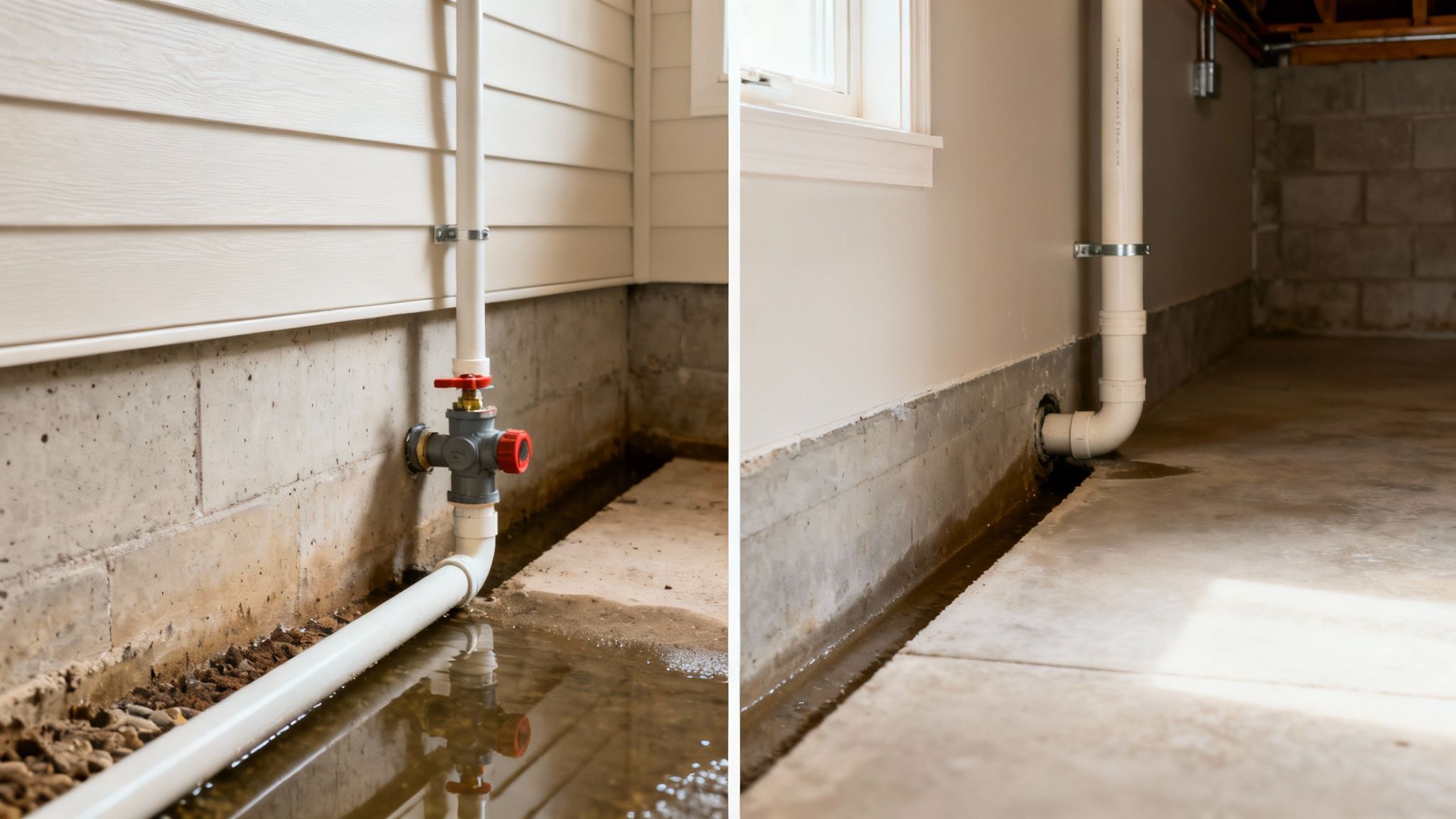
After 25 years in foundations and waterproofing here in Toronto, I’ve been called out to fix more than a few botched backwater valve jobs. A valve that fails during a heavy downpour is worse than having no valve at all. Most of these failures are due to critical mistakes made during installation, not faulty equipment.
The Critical Error of Incorrect Placement
One of the most frequent and costly mistakes is putting the valve in the wrong spot. If the valve is placed too far downstream, fixtures like your basement floor drain or laundry sink are left unprotected. When the city sewer backs up, sewage will pour right into your basement, completely bypassing the valve. Proper placement requires a complete understanding of your home’s plumbing layout to ensure every single fixture is protected.
Improper Slope and Grade Issues
A backwater valve must be installed with a precise slope to let wastewater flow out properly. If the angle is too flat or has a negative slope, it leads to two huge problems:
- Chronic Blockages: Debris and waste get trapped, causing constant clogs and backups inside your home.
- Valve Malfunction: Trapped debris can prevent the valve’s flap from closing all the way, making it useless during a sewer surge.
We often say that a backwater valve installation is 90% science and 10% labour. The science is knowing exactly where to put it and at what angle. Get the science wrong, and the labour is worthless.
Neglecting to Install a Proper Access Box
A backwater valve is a mechanical device that needs regular maintenance. It’s shocking how often we find valves completely buried under concrete with no way to access them. Without an access box, you can’t clear out debris or check that the flap and seal are working correctly. Skipping this step is a classic shortcut that turns a maintainable system into a ticking time bomb. At G1000 Home Substructure, we do it right, or we don’t do it at all.
Cost Factors in Toronto
One of the first questions homeowners in Toronto ask is about the cost of installing a backwater valve. The total investment depends on a few key factors, and understanding them helps you see why a professional job is worth every penny.
Key Factors Influencing the Final Price
The final quote depends on your home’s unique layout, which is why an on-site inspection is essential for an accurate price.
- Depth of Your Main Drain: A shallow pipe is less labour-intensive to access than one buried deep under your foundation.
- Accessibility: A drain in an open, unfinished basement corner is easier to work on than one hidden under a finished floor or behind custom shelving.
- Foundation and Floor Type: Older Toronto homes can have surprisingly thick concrete with rebar, which requires more powerful equipment to cut and restore.
- Complexity of Plumbing: A complex drainage system may require extra planning to find the perfect spot for the valve.
What Is Included in Our Quoted Price
When you get a quote from us, it’s all-inclusive, with no hidden fees.
A professional backwater valve installation is an investment in prevention. The cost is a fraction of the expense and stress of a single sewer backup, which can easily run into tens of thousands of dollars in damages.
Our quotes always include:
- A High-Quality, Code-Compliant Valve
- All City Permit Fees
- Labour and Expertise from Our Licensed Team
- Professional Concrete Restoration
- Coordination of the Final City Inspection
While every job is unique, other waterproofing measures can also be considered. You can explore our guide on the cost of sump pump installation.
Why Choose G1000 Home Substructure?
When you’re facing the threat of a sewer backup in your Toronto home, you need a team that understands the whole picture—how water, soil, and your foundation work together. For over 25 years, we’ve specialized in foundations, exterior waterproofing, and concrete work right here in the GTA. Our expertise goes way beyond a single backwater valve.
A Deeper Understanding of Home Protection
Installing a backwater valve is a structural job. Because our background is in engineer-backed underpinning and concrete services, we approach every project with a structural mindset. We don’t just see a drainpipe; we see a critical part of your home’s long-term health. We consider factors like [hydrostatic pressure] and how a valve must integrate with an existing [sump pump system].
The G1000 No-Shortcuts Guarantee
We have built our reputation on one simple idea: do it right the first time. Our process is transparent, our methods are backed by sound engineering principles, and our commitment is to building solutions that last.
We believe protecting your home is a serious responsibility. A backwater valve isn’t just a piece of hardware; it’s a promise of safety and peace of mind. We deliver on that promise with expert workmanship built to last.
Choosing us means partnering with a local expert dedicated to a reliable, code-compliant solution. From our specialized epoxy floors to our foundational work, every project is a testament to our commitment to quality. To learn more, visit our About page.
Answering Your Questions About Backwater Valves
How Long Does The Installation Take?
For most residential homes, a standard backwater valve installation is a one-day job. We handle the entire process from start to finish within that timeframe, including concrete cutting, excavation, plumbing, and a seamless concrete patch.
Does A Backwater Valve Require Maintenance?
Yes, absolutely. We strongly recommend an annual check-up. Maintenance is simple: open the access cover, clean out any debris, and ensure the flap moves freely. This quick inspection can be the difference between a dry basement and a catastrophic failure during the next big Toronto storm.
Can A Backwater Valve Lower My Home Insurance?
Definitely. Many insurance companies in Ontario offer premium discounts for homes with a professionally installed and permitted backwater valve. Once the job is done, send a copy of the passed municipal inspection report and our final invoice to your insurance provider to unlock potential savings.
Book a Free Inspection in Toronto
If you’re in Toronto and need a professionally installed backwater valve, our team is ready to help. G1000 Home Substructure delivers engineered, long-lasting results to protect your home. Book your free, no-obligation inspection today.

