

Think of a membrane for basement waterproofing as a heavy-duty, impenetrable raincoat for your home's foundation. It's a specialized barrier we apply to the outside of your foundation walls to physically stop water from getting in. This isn't just a simple coat of paint; it's an engineered system designed to resist the constant pressure from groundwater and soil moisture.
Why a Waterproofing Membrane Is Your Foundation's Best Defence
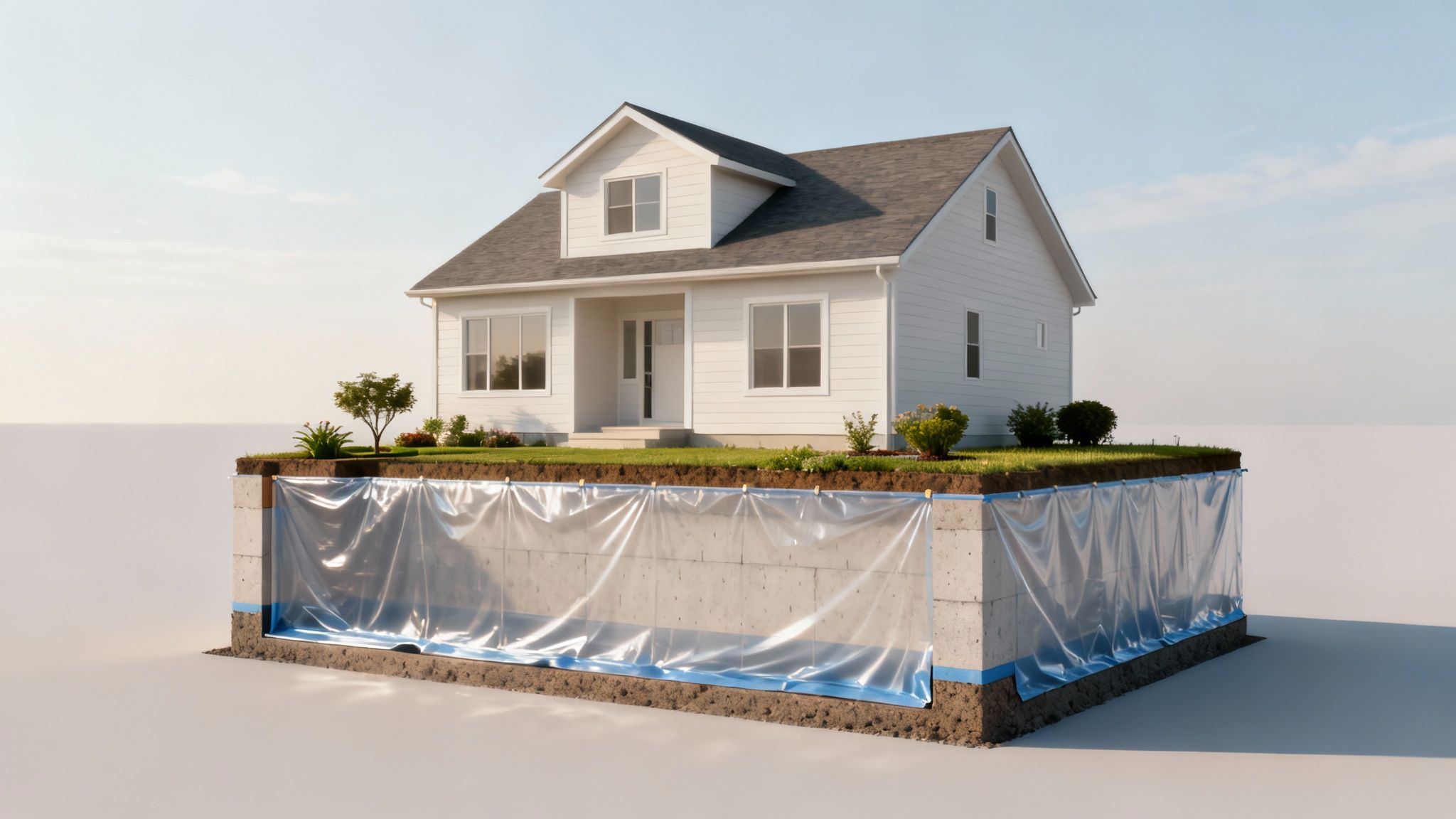
A damp basement can feel like a minor annoyance, but it's often the first sign of a much bigger problem. For homeowners across Toronto and the GTA, where seasonal thaws and heavy rains are a fact of life, keeping your basement dry isn't just a good idea—it's essential for protecting your home.
A quality waterproofing membrane is what stands between the wet soil surrounding your home and the concrete of your foundation. Concrete might seem solid, but it's actually porous. Without a proper barrier, water will eventually find its way through, leading to musty smells, mould, and even serious structural issues over time. This kind of water damage isn't a small problem; it can slash a home's value by as much as 25%. We dive deeper into this in our guide to keeping your basement moisture-free.
You Can't Afford to Ignore a Damp Basement
Let’s be direct: a wet basement is a silent threat to your home and your health. What starts as a little dampness can quickly spiral into a full-blown crisis.
- Mould and Air Quality: That musty smell is a warning sign. Damp, dark basements are the perfect breeding ground for mould and mildew, which can release spores that cause allergies, asthma attacks, and other respiratory problems.
- Foundation Damage: Water is relentless. Over time, it can weaken concrete, cause cracks, and even rust the rebar inside your foundation walls. Wooden support beams can begin to rot, compromising the structural integrity of your entire house.
- Lost Property Value: No one wants to buy a home with a water problem. A history of basement leaks is a huge red flag for potential buyers and can seriously hurt your resale value.
In this guide, we'll cut through the jargon and give you the straightforward information you need. We'll walk you through exactly what a membrane for basement waterproofing is, break down the different types on the market, and explain what a professional installation really involves. Our goal is to empower you with the knowledge to protect your biggest investment.
What Exactly Is a Waterproofing Membrane?
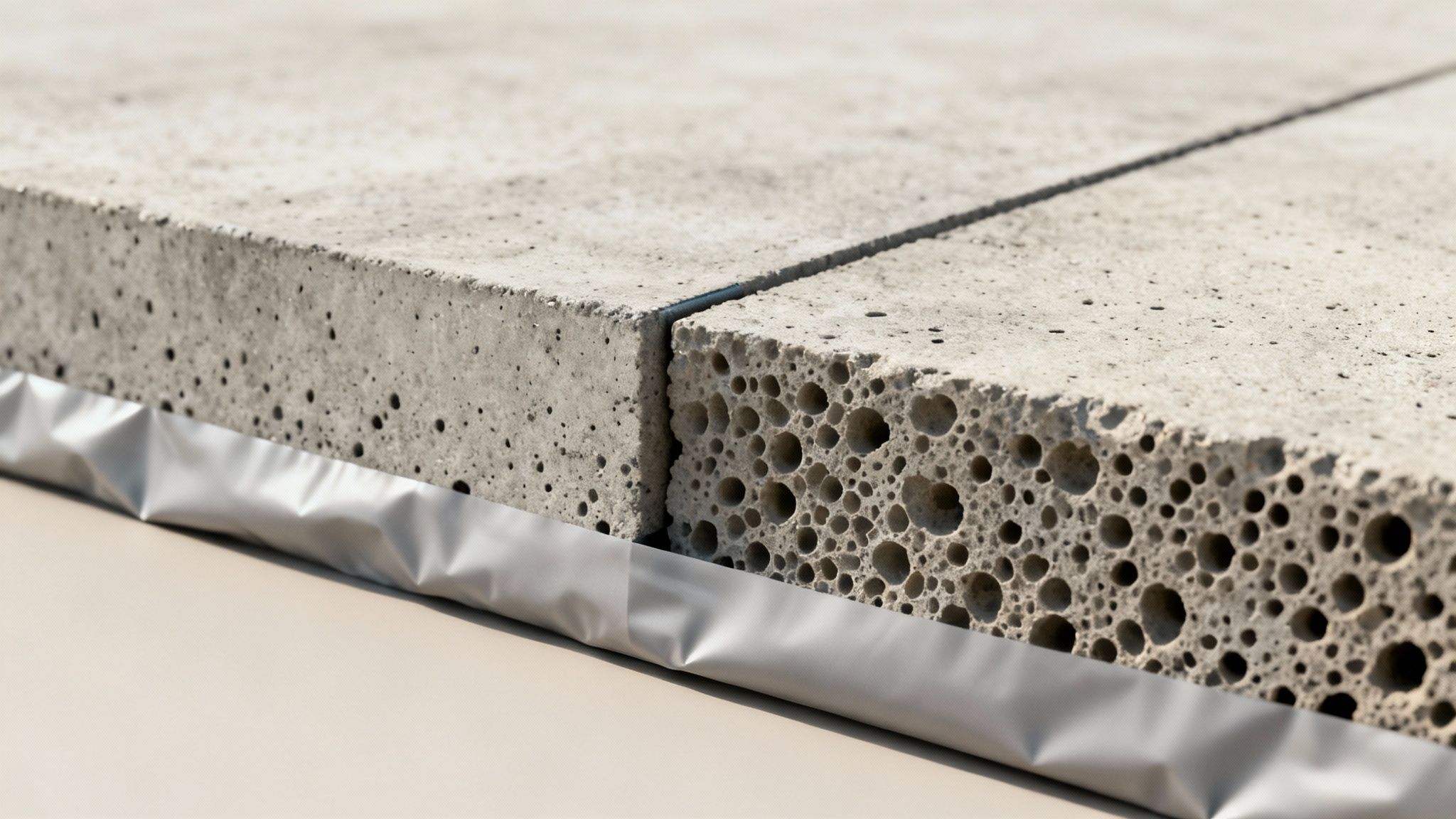
So, what is a membrane for basement waterproofing in plain terms? The best way to think about it is to picture your home's concrete foundation as a really dense sponge. It looks solid, but it's actually filled with countless microscopic pores that will absolutely soak up water from the soil around it.
This becomes a real problem when the ground gets saturated after a big storm or spring thaw. All that water creates immense pressure against your foundation—a force we call hydrostatic pressure. It’s relentless. That water is constantly pushing, looking for any tiny path to get inside, and without a barrier, it eventually will.
A waterproofing membrane is basically a high-performance raincoat that's wrapped around that concrete sponge. Its one and only job is to form a continuous, seamless shield that physically blocks water from ever touching your foundation walls to begin with.
The First Line of Defence, Not the Last Resort
Here’s a critical distinction you must understand: a true waterproofing membrane is a proactive solution installed on the outside of your foundation. It's not something you paint on your interior basement walls after you've already discovered a leak. The goal is to stop water from ever getting in, not just managing it once it’s there.
A proper exterior membrane protects your foundation from the outside in. By stopping moisture at the source—the soil—it prevents the long-term deterioration of concrete, the growth of mould, and the costly structural repairs that follow.
This is a fundamental concept to get right. Many products marketed for interior use are just managing the symptoms of a bigger problem. A genuine membrane for basement waterproofing goes straight to the source and stops the invasion cold.
Engineered for the Harshest Conditions
These aren't just simple sheets of plastic. Modern membranes are sophisticated materials engineered to survive underground for decades. They have to be tough.
Here’s what gives them their staying power:
- Flexibility: A house naturally settles over time. A good membrane can stretch and move with it, bridging minor cracks that might form in the concrete without tearing or failing.
- Durability: They are built to resist punctures from rocks and debris during the backfilling process, and they won't break down from contact with minerals or chemicals in the soil.
- Adhesion: They are designed to bond tenaciously to the foundation. This creates a fully adhered system that stops water from sneaking in behind the membrane even if a small tear were to happen.
By creating this robust, impenetrable shield, the membrane keeps your basement dry, healthy, and structurally sound. It’s a vital investment in protecting the value and integrity of your entire home.
A Look at the Main Types of Waterproofing Membranes
When it comes to picking a waterproofing membrane for your basement, there's no single "best" option for every home. The right choice really hinges on a few key things: your foundation type, the age of your house, and the specific water problems you're trying to solve. Ultimately, the goal is always the same—to create a tough, seamless barrier that keeps moisture out for good.
To make the right call, you need to get familiar with the two main categories of membranes used on homes across the GTA. Each one is applied differently and shines in different situations. Think of them as two specialized tools in a waterproofing expert’s kit, each picked for a specific job.
Sheet-Based Membranes
Sheet-based membranes are often called “peel-and-stick,” which pretty much sums them up. They're thick, rubberized asphalt or plastic sheets that are made in a factory and shipped in big rolls. One side has a super-strong adhesive, allowing it to be stuck directly onto a properly prepared foundation wall.
Picture it like applying a huge, heavy-duty bandage around your foundation. For it to work, the application has to be flawless. Every single seam where one sheet overlaps the next must be sealed perfectly, leaving no gaps for water to exploit.
- Consistent Thickness: Since they're factory-made, you get a guaranteed, uniform thickness across the entire wall.
- Puncture Resistance: Their sturdy build makes them highly resistant to damage from rocks or sharp objects when the soil is backfilled.
- Ideal for New Construction: These are a go-to for new homes with smooth, poured concrete foundations, where long, straight walls make installation relatively simple.
The biggest headache with sheet membranes is getting a watertight seal around odd shapes like pipes, corners, and the foundation footing. This is where professional skill is absolutely essential.
Fluid-Applied Membranes
Fluid-applied membranes, on the other hand, start out as a liquid. This is usually a polymer-modified asphalt or a polyurethane compound that gets sprayed or rolled right onto the foundation. It then cures and hardens into a seamless, rubbery layer that's fully bonded to the wall.
The killer feature here is that it's completely monolithic. There are no seams, no joints, and no overlaps. It forms one single, unbroken barrier that's perfectly custom-moulded to every contour and imperfection of your foundation.
This seamless quality is a game-changer for older Toronto homes with rubble or fieldstone foundations. The rough, uneven surfaces of these old walls make it nearly impossible to get a perfect seal with a stiff sheet membrane. A fluid-applied product, however, flows into every nook and cranny.
This method guarantees total coverage, leaving zero paths for water to find its way in. Because it bonds directly to the concrete, even if one small spot gets punctured, water can't travel behind the membrane to find another weak point. As you look into the best materials, it's worth checking out the top waterproofing products known for durability and seeing what the pros use.
For the majority of waterproofing jobs, especially on existing homes with less-than-perfect foundations, the flexibility and seamless finish of a fluid-applied membrane provide a much higher level of protection. It adapts to your home, rather than trying to make a rigid product fit an imperfect surface.
To help you see the differences side-by-side, here's a quick comparison of the two main types.
Comparison of Basement Waterproofing Membrane Types
| Feature | Sheet-Based Membranes (e.g., Peel-and-Stick) | Fluid-Applied Membranes (e.g., Sprayed-On) |
|---|---|---|
| Application | Adhered in overlapping sheets. Seams must be sealed. | Sprayed, rolled, or troweled on as a liquid. |
| Seams | Multiple seams that require precise sealing. | Completely seamless (monolithic). |
| Flexibility | Less flexible; can be difficult to apply on uneven surfaces. | Highly flexible; conforms perfectly to any shape. |
| Ideal Use Case | New construction with smooth, uniform foundation walls. | Older homes, irregular foundations, and complex shapes. |
| Thickness Control | Uniform thickness is guaranteed by the manufacturer. | Thickness depends on the skill of the applicator. |
| Bonding | Adheres to the substrate, but water can travel behind if a seam fails. | Fully bonded; prevents water from migrating behind the membrane. |
Ultimately, both have their place, but fluid-applied systems offer a more versatile and foolproof solution for the varied and often challenging conditions we see in residential waterproofing.
Choosing the Right Membrane for Your Basement
Picking the best membrane for basement waterproofing isn't as simple as grabbing the most expensive option from the hardware store. It’s a decision that hinges entirely on the specifics of your home. What works perfectly for a brand-new build with smooth concrete walls is often the wrong choice for a century-old Toronto home with a rugged stone foundation.
The real goal here is to match the solution to the problem. A seasoned contractor knows you don't use a sledgehammer to hang a picture, and the same thinking applies to waterproofing. Let's walk through the key things you need to weigh, so you can think like a pro and choose a solution that will protect your property for the long haul.
Your Foundation Material is a Game-Changer
First thing's first: what are your foundation walls actually made of? Answering this one question will immediately cut through the noise and point you in the right direction.
- Poured Concrete: If you're in a newer home, you likely have this. The walls are smooth and consistent, which means they're a good surface for either a sheet-based membrane or a fluid-applied one. Both can get a really solid bond on a clean, uniform surface.
- Concrete Block (CMU): These walls are built from individual blocks with mortar joints in between. As the house settles and ages, those mortar joints are the first place water will try to sneak in. A fluid-applied membrane really shines here, since it creates a single, seamless layer that seals over every last joint, leaving no weak spots.
- Stone or Rubble Foundations: These are the beautiful, historic foundations you see in many older GTA homes. They're also irregular, uneven, and packed with countless little gaps and crevices. Trying to stick a rigid sheet membrane on a surface like this is a recipe for failure. A fluid-applied membrane is really the only reliable choice, as it can flow into every imperfection to create a perfectly custom, watertight seal.
Taking Stock of Your Water Problems and Budget
Next, you have to get real about the scale of your water issue and what you're prepared to invest.
Dealing with a bit of dampness that only shows up after a solid week of rain is one thing. It's a completely different ball game if your basement has active leaks, puddles, or constant, sticky humidity. More severe water problems are a dead giveaway that you're fighting significant hydrostatic pressure—water in the soil pushing against your foundation. This means you need the toughest, most flawlessly applied membrane you can get.
Think of it like this: a light windbreaker is fine in a drizzle, but you need a full GORE-TEX® rain suit for a monsoon. Serious water pressure is the monsoon of basement waterproofing; it calls for a high-performance system installed by pros. This is absolutely not the place to cut corners.
Of course, your budget is a real-world factor. A full exterior excavation and membrane application is the undisputed champion of waterproofing, but it's a major investment. The best way to look at it is as a permanent fix that protects your home’s value and structural integrity. When you weigh that against the cost of dealing with mould, rot, and foundation damage down the road, you'll find the cost of inaction is always, always higher.
The Waterproofing Process from Start to Finish
Knowing how a professional membrane for basement waterproofing is installed can take away a lot of the anxiety that comes with a big home project. When you know what to expect, you feel more confident that the job is being done right. We're big believers in transparency, so let's walk through the entire process step-by-step, just as if we were explaining it at your kitchen table.
This isn’t a rush job; it’s a methodical, proven process that leaves no room for error. Every single stage is designed to make sure your foundation is completely and permanently sealed against water.
Stage 1: Excavation and Preparation
The whole journey begins with careful excavation. A professional crew will dig a trench around the full perimeter of your foundation, exposing the walls all the way down to the footings—that’s the concrete base your house sits on. This isn't just rough digging; it’s a precise operation to ensure safety and provide clear access to the entire wall surface.
Once the walls are exposed, the real prep work begins. They are cleaned meticulously with pressure washers and wire brushes to scrub off years of dirt, clay, and any old, failing coatings. This step is absolutely critical. The new membrane needs a perfectly clean surface to create a permanent bond.
Stage 2: Wall Repair and Membrane Application
With the walls clean, we inspect every inch for cracks, holes, or crumbling mortar joints. Any imperfections we find are repaired and sealed. We don't just cover up problems; we fix them first. This ensures the foundation is structurally sound before we seal it up.
Next comes the main event: applying the waterproofing membrane. Whether it’s a fluid-applied or sheet-based system, it’s applied with an incredible amount of attention to detail. The goal is to create a single, continuous barrier that covers every square inch of the wall, from ground level right down to the footing. There can be no gaps, no seams, and no weak points.
This simple infographic breaks down the core factors—your foundation type, the specific water problem, and your budget—that guide the decision-making process.
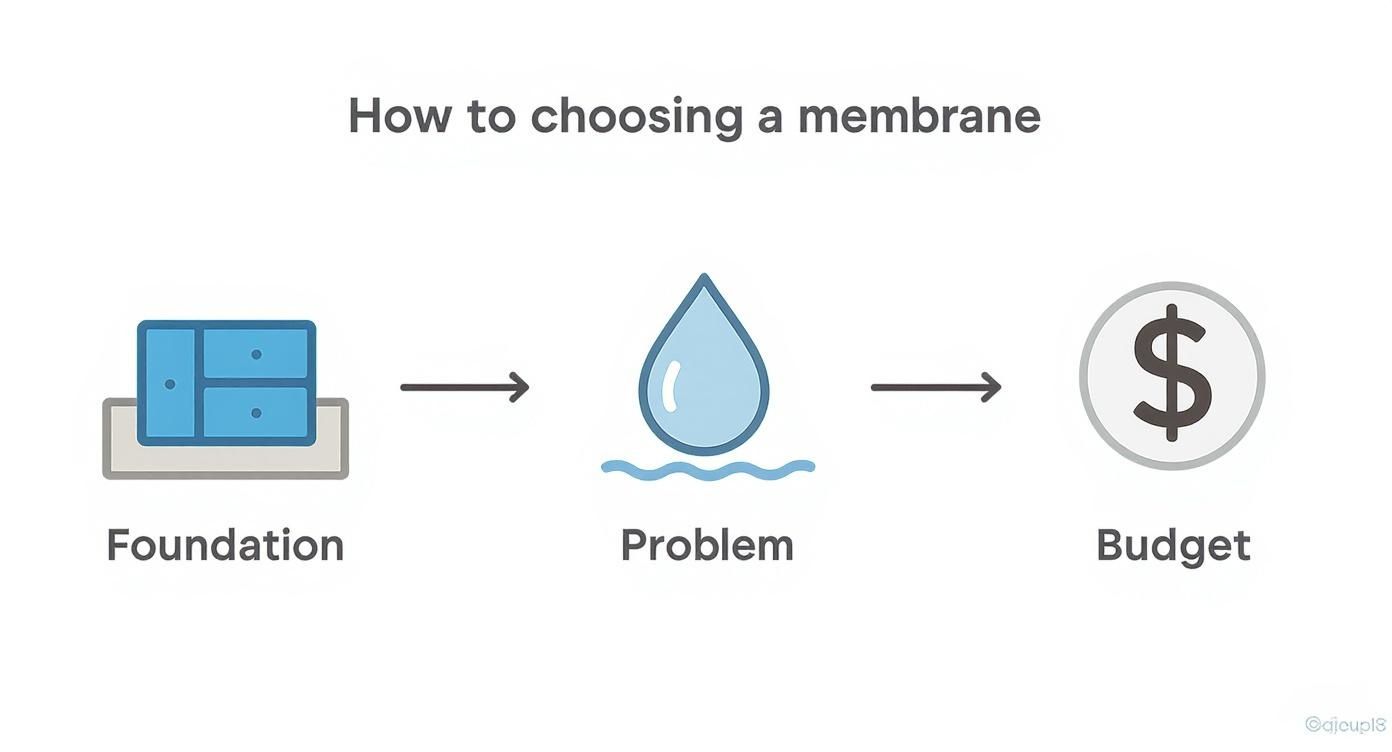
As you can see, a professional assessment connects the physical state of your home to the most effective and cost-efficient waterproofing solution.
Stage 3: Drainage and Backfilling
A waterproofing membrane is your foundation's first line of defence, but it works best as part of a complete system. After the membrane cures, a brand-new weeping tile system (also called a drain tile) is installed at the base of the footing. This perforated pipe is designed to collect groundwater and safely channel it away from your foundation, which helps relieve that intense hydrostatic pressure.
The weeping tile is then covered with a layer of clear gravel to keep it from clogging. Finally, the excavated soil is carefully backfilled into the trench. The area is then graded to ensure surface water flows away from your house, not towards it. The industry's growth is a testament to how well these systems work; the North American market was valued at USD 389 million in 2022, reflecting the demand for reliable, long-term solutions. You can discover more about these market trends and their drivers if you're interested.
At the end of the process, your home isn't just patched—it's permanently protected by a multi-layered system designed to keep your basement dry for decades to come.
Understanding the Costs and Long-Term Value
Let's get straight to the point: what does installing a membrane for basement waterproofing actually cost? The honest answer is, it varies. The final bill will depend on a few key things, like the size of your basement, how deep we need to dig, and which specific membrane system is right for your home.
It’s tempting to just look at the bottom line, but I always encourage homeowners to see this as a long-term investment in their property's health and value, not just an expense. A properly waterproofed basement is your first line of defence, protecting your home’s entire structure from the ground up. You’re not just stopping a leak; you're preventing a cascade of future problems like foundation decay, mould growth, and other expensive water damage repairs.
The True Value of a Dry Basement
Ignoring a damp basement or a small leak won't make the problem disappear. In my experience, it just guarantees a much bigger, more expensive headache down the road. The cost of doing nothing is always higher in the long run.
By investing in a proper exterior membrane, you're not just fixing a leak. You're preserving your property's value, protecting your family's health, and adding usable, safe square footage to your home.
So, what kind of numbers are we talking about? As a general guideline, the cost often falls somewhere between $3 and $10 per square foot. Your basement's size is the biggest driver here. For instance, waterproofing a 1,200-square-foot basement could range from $4,800 to $9,600, depending on the method used. You can learn more about waterproofing cost estimates in other regions to get a sense of how these figures stack up.
Ultimately, the peace of mind that comes from knowing your foundation is permanently dry is priceless. We dive much deeper into this in our complete guide on the cost of basement waterproofing and how to budget for it.
Common Questions About Waterproofing Membranes
Even after you've got your head around the basics, it's normal to have a few lingering questions. As a contractor, I’ve sat at countless kitchen tables and heard just about every concern imaginable. Here are some no-nonsense answers to the questions that pop up most often about a membrane for basement waterproofing.
How Long Does a Waterproofing Membrane Last?
A properly installed, high-quality exterior membrane isn't a temporary fix; it's a permanent one. We're talking about materials like polymer-modified liquids, which are specifically engineered to last the entire lifespan of your home.
These membranes are designed to stay flexible and tightly bonded to the foundation, fighting off soil chemicals and constant pressure for decades without giving up. Simply put: once the job is done right, you should never have to think about it again. It becomes a permanent, integral part of your home’s defence against water.
Is an Exterior Membrane Better Than Interior Solutions?
Yes, and it’s not even a close contest. Interior waterproofing systems are fundamentally designed to manage water after it has already seeped through your foundation walls. An exterior membrane for basement waterproofing, on the other hand, stops water from ever touching your foundation in the first place.
By blocking moisture at its source—the surrounding soil—an exterior membrane protects the concrete itself from the slow, damaging effects of saturation. Interior systems might keep your floor dry, but they do nothing to protect the long-term structural integrity of your foundation.
Is a Full Membrane Necessary for Minor Dampness?
Even a little bit of occasional dampness is a red flag. It’s a clear sign that water is already making its way through your foundation. While it might not seem like a big deal now, that moisture is creating the perfect breeding ground for mould and will eventually lead to bigger issues like cracks and concrete decay.
Think of applying a membrane as a proactive strategy. It addresses the root cause of the dampness rather than just putting a band-aid on the symptoms. This ensures the problem is solved for good, preventing it from spiralling into a much more expensive structural repair down the road.
At G1000 Home Substructure, our entire philosophy is built on providing permanent solutions that protect your home and your peace of mind. If you have more questions or need a professional eye on your foundation, we're here to give you clear, honest answers.
Schedule Your Free, No-Obligation Consultation with Our Experts Today

